
Chinnaswamy Stadium Pitch Report: Scores, Records and Trends

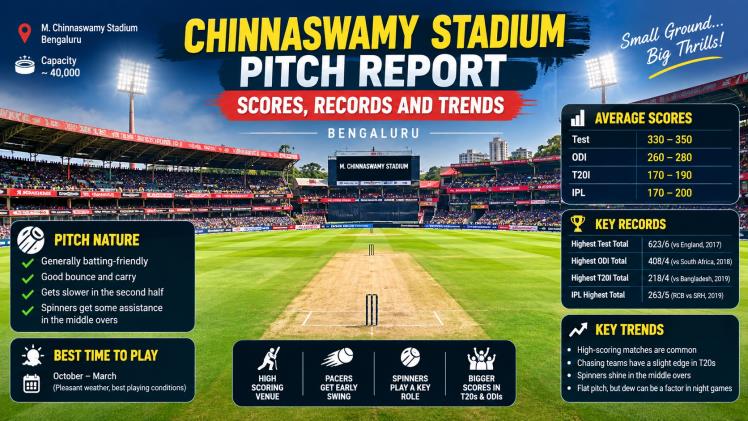
Chinnaswamy Stadium is generally a batting-friendly venue in limited-overs cricket, but it is not an automatic run-fest every time. Its short boundaries reward clean hitting, while a flat surface can make controlling the run rate difficult for bowlers. At the same time, recent domestic T20 results show that totals below 150 and modest successful chases have also occurred, so the specific pitch, match situation and bowling quality remain important.
Is Chinnaswamy Stadium Better for Batting or Bowling?
The broad answer is batting. Bengaluru’s compact dimensions and quick scoring conditions put a premium on timing, power and smart shot selection. A batter who finds the gaps or clears the infield can quickly change the course of an innings. The venue has often produced totals beyond 190 in domestic T20 cricket, and the highest domestic T20 score listed at the ground is 287/3 by Sunrisers Hyderabad.
That reputation does not mean bowlers have no role. New-ball bowlers can still create pressure through disciplined lengths and changes of pace, particularly when batters try to force the tempo from the outset. Spinners are reported to receive some assistance, though they need to be precise because missed lengths can be punished. At a venue with smaller boundaries, defensive bowling without a clear plan can be expensive.
The listed ground dimensions underline why boundary-hitting is such a major part of the contest: the square boundary is 54 metres and the straight boundary is 60 metres. Those distances encourage teams to target match-ups aggressively, especially against bowlers operating into a batter’s stronger arc. It also means that saving a single or turning a likely boundary into two runs can be as valuable as attempting a spectacular catch.
T20 Scoring Pattern at the Venue
The domestic T20 figures offer the clearest picture of the venue’s scoring range. Across 202 domestic T20 matches, the average first-innings score is 168. Teams batting first won 87 matches, while teams batting second won 113, with two ties. That split suggests that chasing has been slightly more successful overall, though it does not establish that chasing will always be the preferable option.
| Domestic T20 statistic at M. Chinnaswamy Stadium | Figure |
| Matches played | 202 |
| Average first-innings score | 168 |
| Wins batting first | 87 |
| Wins batting second | 113 |
| Ties | 2 |
| Scores below 150 | 58 |
| Scores from 150 to 169 | 47 |
| Scores from 170 to 189 | 42 |
| Scores above 190 | 55 |
The table shows why a simple “200-plus ground” label can be misleading. Scores above 190 occurred in 55 of those domestic T20 matches, the largest single scoring band, but 58 first-innings totals were below 150. Conditions can therefore vary substantially. A strong target is possible, yet a team must still assess the surface rather than rely on the ground’s reputation.
For readers trying to follow venue-based cricket information alongside score trends and match context, winmatch365-in.vip can be used as an additional reference point. The more useful approach is to compare any projected total with the match’s format, the bowling attacks involved and whether the surface appears fresh or has already been used.
What Is a Competitive T20 Score?
Based on the domestic T20 average, a first-innings total around 168 represents a reasonable baseline rather than a guaranteed winning score. A side reaching 170 to 180 gives itself a meaningful platform, especially if it has bowlers capable of defending under pressure. However, on a surface that is coming nicely onto the bat, that range can remain chaseable.
A score above 190 has historically been a significant mark at the venue, but even that is not beyond pursuit. The shorter boundaries mean a chasing team can recover quickly after a quiet over or two. The key distinction is not just the final score; it is the number of wickets in hand at the halfway stage and whether the batting side has enough power hitters for the last five overs.
The flip side is that low totals are possible. In a domestic T20 match on 18 April 2025, Royal Challengers Bengaluru made 95/9 against Punjab Kings, who reached 98/5 to win by five wickets. That result is a reminder that batting collapses, early wickets and changing conditions can outweigh a ground’s usual scoring profile. Teams should not treat the stadium’s dimensions as a substitute for sound batting.
Chasing Record and Toss Considerations
The domestic T20 record gives a modest advantage to teams batting second: 113 wins compared with 87 for teams batting first. In the smaller sample of nine men’s T20 internationals at the ground, teams batting second won five matches and sides batting first won four. Neither set of figures makes the toss decisive, but both show that chasing has been viable.
Captains still need to judge the day’s pitch rather than make a decision from historical results alone. A fresh surface with consistent pace may encourage a chase, since the target is known and a batting order can pace itself accordingly. Conversely, if the pitch looks dry or likely to slow down, setting a total may have greater value because batting later could become more difficult.
A recent example of a successful chase came on 24 April 2026, when Gujarat Titans posted 205/3 and Royal Challengers Bengaluru replied with 206/5. The match showed that even a total above 200 does not remove the chasing side’s opportunity. It also reflected the importance of wickets: a batting side that retains enough resources can continue attacking deep into the innings.
Notable T20 Match Records
The highest domestic T20 score listed for the ground is Sunrisers Hyderabad’s 287/3, an illustration of the extraordinary scoring ceiling available when conditions and execution align. The lowest score in the same domestic T20 set is Royal Challengers Bengaluru’s 82/10. Together, those extremes make an important point: the stadium favours positive batting, but it can also expose a side that loses wickets early.
Several recent fixtures demonstrate the range. Royal Challengers Bengaluru made 250/3 against Chennai Super Kings on 5 April 2026 and won by 43 runs after Chennai Super Kings were dismissed for 207. On 15 April 2026, Lucknow Super Giants were bowled out for 146 before Royal Challengers Bengaluru completed a five-wicket chase at 149/5. The contrast between those games shows why a pitch report is guidance, not a prediction.
The 3 May 2025 match between Royal Challengers Bengaluru and Chennai Super Kings was another high-scoring finish. Royal Challengers Bengaluru scored 213/5, while Chennai Super Kings finished on 211/5, with the home side winning by two runs. In such matches, small phases—an economical over, a dropped chance, or a boundary stopped near the rope—can have a greater impact than the overall nature of the pitch.
How Bowlers Can Adapt in Bengaluru
Fast bowlers need to avoid predictable back-of-a-length bowling that sits up for horizontal-bat shots. Yorkers, slower deliveries and wide lines outside off stump can be useful when executed accurately. Bowlers also need clear field plans, since the short boundaries can make conventional defensive fields insufficient against set batters.
Spinners may get some turn, but their main challenge is varying pace and trajectory while protecting both sides of the ground. A spinner who forces the batter to hit toward the longer part of the boundary can create wicket-taking chances. The priority is control: one loose over can dramatically alter the required rate or turn a manageable total into a daunting one.
Conclusion
Chinnaswamy Stadium remains a venue that usually rewards intent and attacking batting, particularly in T20 cricket. Its domestic first-innings average of 168 and its strong chasing record show that it offers more than one route to victory. Big totals are possible, but teams that adapt to the particular surface, preserve wickets and bowl with discipline are best placed to succeed.